Character
The Story of Egyptian jasmine
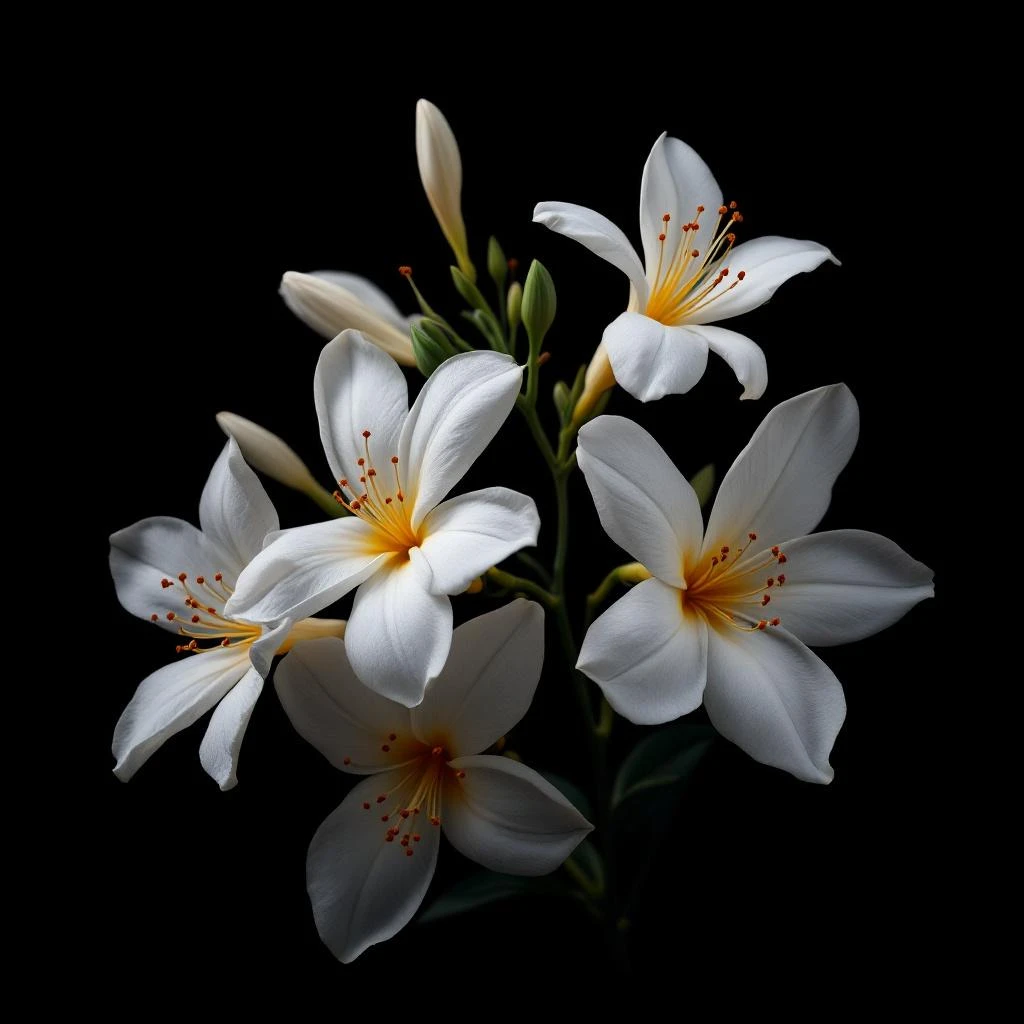
Egyptian jasmine absolute ranks among the most precious natural materials in perfumery. The warm, diffusive floralcy bridges luminous transparency with deep sensuality, making it indispensable in fine fragrances. Harvested at night when blossoms release peak aroma, this golden-orange absolute serves as both heart and soul of iconic compositions.
Heritage
The name jasmine descends from the Arabic "yasmeen," reflecting the flower's ancient roots in Middle Eastern and South Asian cultures. Native to Himalayan valleys, jasmine traveled westward with merchants and conquering armies. The Moors introduced both J. grandiflorum and J. officinale to North Africa and Spain during their expansion, from where cultivation spread to southern France during the 16th century. Grasse emerged as the center of European jasmine production, developing extraction techniques that would define the industry. By the 1860s, grafted varieties combining J. grandiflorum with hardy J. officinale rootstock enabled cultivation beyond Mediterranean climates. Industrial jasmine production shifted decisively to Egypt during the early 20th century, where warmer temperatures and abundant labor created superior economic conditions. Egyptian jasmine absolute earned worldwide recognition for its consistent quality and complex aromatic profile. The flower holds deep cultural significance beyond perfumery, appearing in Indian temple offerings, Chinese celebrations of femininity, and medieval European art symbolizing the Virgin Mary. Grasse perfumers affectionately call jasmine "The Flower," a testament to its foundational role in classical fragrance creation.
At a Glance
4
Feature this note
Egypt
Primary source region
Ingredient Details
Solvent extraction (hexane to concrete, alcohol to absolute)
Flowers
Did You Know
"Harvesters must pick jasmine flowers before sunrise while buds are still closed, yet the strongest aroma develops only when the blossoms open at night."