


The Heritage
The Story of F. Millot
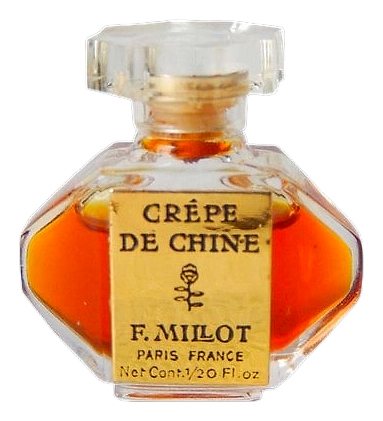
F. Millot began in Paris in the mid‑19th century and grew into a quiet but influential perfume house. Over a century the brand released more than thirty fragrances, including the chypre Crêpe de Chine (1925) and the aromatic L’Insolent (1947). Though it never chased headlines, the house earned a reputation for balanced compositions that appealed to connoisseurs. In 1966 the label passed to Révillon, but its historic bottles still appear in museum collections and private libraries.
Heritage
The story starts in 1819 when a perfumery opened in Paris for a Madame Millot. Félix Adolph Millot (1801‑1863) acquired the shop a few years later and renamed it after his family. He moved the business to a modest workshop on rue du Faubourg Saint‑Honoré and began to sell both raw essences and finished extracts. In 1860 Félix Millot’s son, also named Félix, officially founded the brand that would bear the family name. He entered the trade at age thirty, describing himself as a merchant‑manufacturer rather than a creator. The younger Millot focused on sourcing high‑quality raw materials from the Mediterranean, the Middle East and the colonies, then blending them in small batches. By the turn of the century the house launched Kantirix (1900), its first documented fragrance, followed by a steady stream of releases that reflected the changing tastes of Parisian society. Crêpe de Chine (1925) introduced a novel chypre structure that later scholars cite as a turning point in early modern perfumery. The interwar period saw the launch of Récital (1931) and Bois Précieux (1933), both praised for their refined balance of woods and florals. After World War II the house issued L’Insolent (1947) and Revelry (1948), scents that combined bright citrus top notes with deeper amber bases. The final original launch, Partner (1959), marked the end of an era; the brand’s creative output slowed as market pressures grew. In 1966 Révillon perfumes acquired the Millot name, integrating its archives into a larger portfolio. Today, the original bottles and formulas reside in the Osmothèque, France’s perfume conservatory, where Crêpe de Chine is listed as the first perfume entered into the collection. The Millot legacy endures as a reference point for scholars studying the evolution of French chypre and aromatic styles.
Craftsmanship
The Millot workshop operated on a small scale, allowing master artisans to oversee each batch from raw material arrival to final bottling. Ingredients arrived in glass jars or wooden barrels, and each shipment was logged in a ledger that recorded harvest dates, origin and quality grade. The house favored natural extracts, using steam distillation for citrus oils, solvent extraction for delicate florals and enfleurage for rare absolutes. After initial extraction, the raw essences were aged in oak casks for several months to develop depth. Blending took place on a marble table, where the perfumer measured each component with a graduated pipette, then stirred the mixture by hand. Once the formula reached the target profile, it was transferred to a copper still for maceration, a step that allowed the volatile compounds to integrate fully. The final perfume was filtered through fine muslin, then poured into hand‑blown glass bottles sealed with a waxed cork. Quality control involved a panel of senior staff who sampled each batch at three stages: post‑blend, post‑maceration and post‑bottling. Any deviation prompted a repeat of the offending step. The house also kept detailed records of ingredient provenance, which later helped historians verify the authenticity of vintage Millot scents. This meticulous process contributed to the longevity of formulas that still survive in museum collections.
Design Language
F. Millot’s visual language mirrors its restrained olfactory style. Early bottles feature simple crystal or clear glass, allowing the perfume’s color to become the focal point. Labels are typographically modest, using a serif font in black ink on cream‑colored paper. The brand’s logo—a stylized “F” intertwined with a subtle mill wheel—appears in gold foil on the cap, hinting at the family’s rural origins. In the 1930s the house introduced a rectangular bottle with a brushed metal stopper, a design that signaled modernity without abandoning elegance. Crêpe de Chine’s original packaging used a deep amber glass, protecting the chypre from light while conveying warmth. Later releases, such as L’Insolent, adopted a dark green bottle with a matte finish, reflecting the scent’s bold character. Throughout its history the brand avoided excessive ornamentation, preferring clean lines and understated details that let the perfume speak for itself. Contemporary reissues retain these classic elements, often adding a discreet vintage label that references the original launch year.
Philosophy
F. Millot approached scent as a dialogue between nature and the laboratory. The house believed that a perfume should respect the character of each ingredient while allowing the composition to evolve on the skin. This modest philosophy discouraged flashy marketing and instead encouraged perfumers to study raw materials in depth. The brand valued consistency, so it kept the same sourcing routes for key notes such as oakmoss, bergamot and labdanum for decades. It also embraced a holistic view of well‑being, expanding into dermo‑cosmetics in the 1950s to offer products that cared for both scent and skin health. By treating fragrance as part of a broader lifestyle, Millot aimed to create scents that felt timeless rather than trend‑driven. The company’s archives show a preference for balanced structures, where top, heart and base notes interact without one dominating the others. This restraint reflects a belief that elegance arises from restraint, not excess.
Key Milestones
1819
A perfumery opens in Paris for Madame Millot.
1860
Félix Millot officially founds the F. Millot house.
1900
First documented fragrance, Kantirix, is released.
1925
Crêpe de Chine launches, later recognized as a pioneering chypre.
1947
L’Insolent debuts, showcasing post‑war aromatic trends.
1966
Révillon perfumes acquires the F. Millot brand.
At a Glance
Brand profile snapshot
Origin
France
Founded
1860
Heritage
166
Years active
Collection
1
Fragrances released
Avg Rating
4.6
Community sentiment
Release Rhythm